How Commercial Cleaning Methods Have Changed
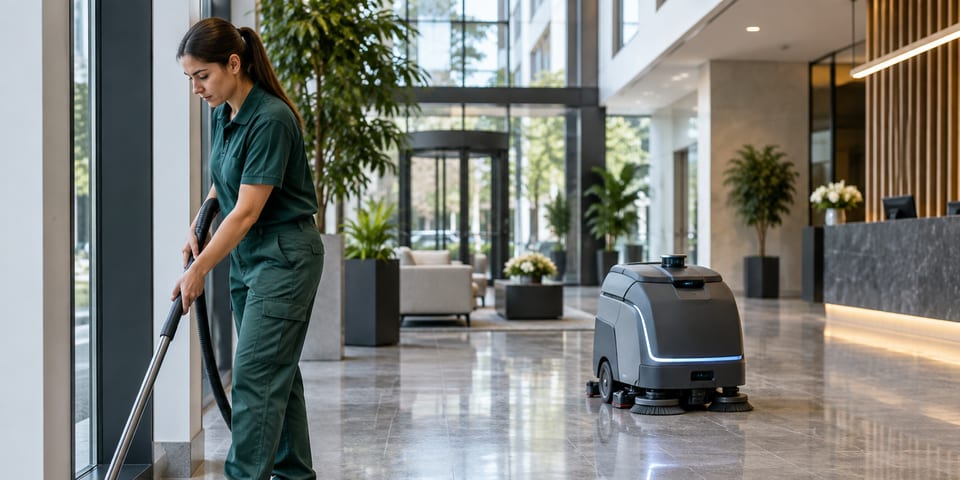
The goal of cleaning has not changed: remove dust, dirt and grime, and leave surfaces safe to touch. The tools have. Mops became microfibre, brooms became HEPA vacuums, and robotic scrubbers now run in some large open spaces. That raises a fair question for anyone buying commercial cleaning: will machines replace the crew?
At a glance:
- What has changed, and what has not
- Where robots help
- Where people are still needed
- How the two work together
What Has Changed, and What Has Not
Many old methods are still the right ones; modern equipment just makes them faster and more thorough.
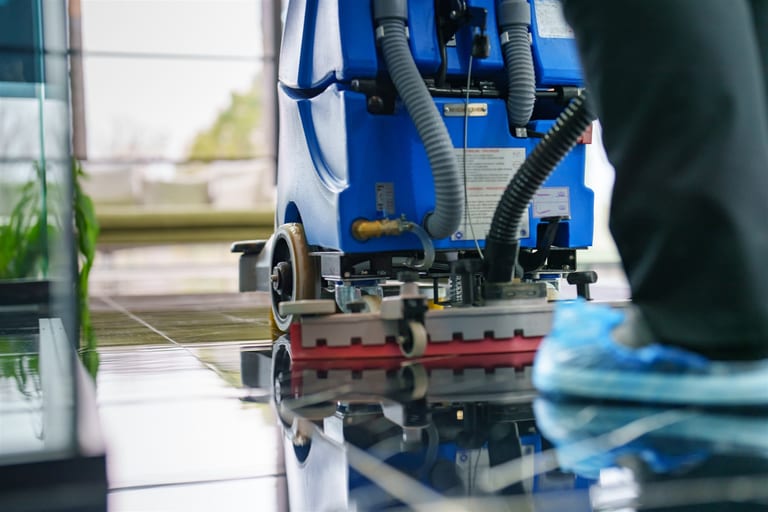
- Floors. The sequence is the same as it always was: remove loose dirt, scrub what is embedded, rinse, dry, and protect the finish. Brooms and dust mops have largely given way to vacuums with sealed filtration, and cotton string mops to microfibre, which holds water better, picks up more dirt and lasts far longer. On large hard floors, a machine scrubber does the scrubbing, rinsing and drying in one pass.
- Cloths. Microfibre has replaced cotton for most dusting and wiping because it traps dust instead of moving it. Cloths are colour-coded by area so washroom cloths never reach a kitchen.
- Products. Soaps and detergents have been around for a long time, but there are now far more low-residue and environmentally preferable options. Detergents are synthetic, soaps are made from fats and oils, and a product labelled “natural” is not always so: read the label, and look for products free of ingredients such as phthalates, ammonia, triclosan and parabens.
- Hot water. Still one of the best ways to cut grease, now delivered by extraction machines for carpets and scrubbers for floors.
Where Robots Help
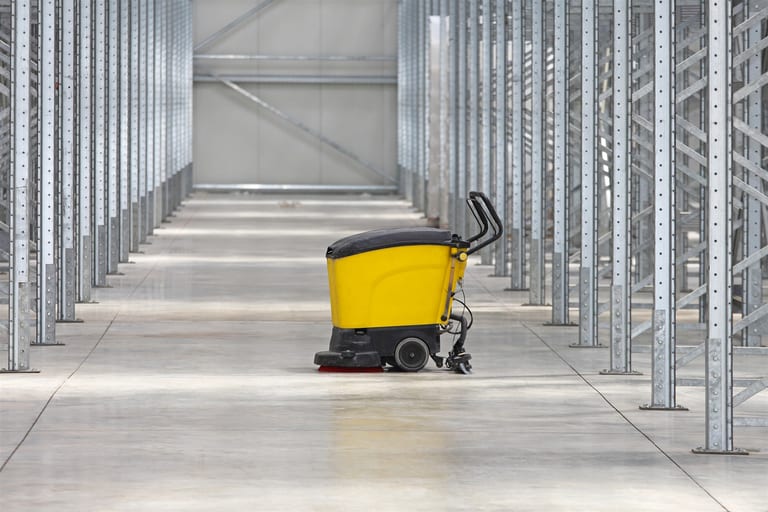
Robotic and autonomous scrubbers are good at one thing: covering a large, open, uncluttered floor on a repeating route. In a big warehouse aisle or a wide lobby, they keep a floor clean between visits without supervision.
They can also run at hours when no one is in the building, and they log their own runs: how long, how much area, when. That data is useful for planning, as long as someone reads it and acts on it.
Where People Are Still Needed
- Edges, corners and clutter. Robots miss what they cannot reach: under desks, around chair legs, along baseboards, behind doors. Someone has to finish those areas and check the robot’s work.
- Everything that is not a floor. Washrooms, kitchens, desks, glass and touch points are all detail work that machines do not do.
- Judgement. A spill, a stain, a damaged surface or a door left unlocked needs someone to notice it and decide what to do.
- Maintenance. Machines need charging, emptying, cleaning and repair, and they need to be disinfected themselves.
- Instructions. Clients want to talk to the people cleaning their building: to ask for a change, point out a problem or explain a site rule. A robot cannot take that conversation.
How the Two Work Together
The realistic future is not robots or people but both: machines for the repetitive floor work in large spaces, and trained crews for everything else, including supervising the machines. Better equipment lets a crew spend its time where it matters most.
At Evergreen, our crews use modern equipment (sealed HEPA vacuums, microfibre systems, auto-scrubbers and burnishers) on a written scope set for your building. Contact us to talk about yours.
For warehouses and other large floors, Evergreen’s industrial cleaning combines machine scrubbing with a crew for the edges and everything else.